Last updated: May 27, 2026
An electric hoist is powered lifting equipment designed mainly to raise and lower suspended loads. An electric winch is powered pulling equipment designed mainly to pull, drag or recover loads with a wire rope or synthetic rope. The difference matters because a machine that is suitable for horizontal pulling is not automatically suitable for vertical lifting.
If you know the load, height and voltage, send a quote request now.
Quick Answer
Choose an electric hoist when the job is repeated vertical lifting, such as moving parts onto a workbench, lifting goods in a warehouse, handling molds or raising materials on a construction site. Choose an electric winch when the job is pulling, recovery, trailer loading or moving a load across a surface. If a product is described as a "winch hoist," confirm the rated capacity for vertical lifting, rope length, braking system, mounting method and duty cycle before purchase.
For factory buyers, the safest rule is simple: use a hoist for lifting, use a winch for pulling, and only use a winch for lifting when the manufacturer clearly rates that configuration for suspended loads.
For a quick recommendation, send load, direction, voltage and quantity.
Electric Hoist vs Electric Winch: Core Difference
The main difference between an electric hoist and an electric winch is load direction. A hoist is built around controlled vertical lifting. A winch is built around line pull, usually horizontal or inclined. Both may use wire rope, motors and hooks, but their design assumptions are different.
OSHA defines rated load as the maximum load for which a crane or individual hoist is designed and built by the manufacturer and shown on the nameplate. For buyers, the label must match the way the equipment is actually used.
A Plain-English Definition
An electric hoist lifts a load up and down. An electric winch pulls a load toward the machine. Some equipment can do both, but only within the capacity and configuration stated by the manufacturer.
Buyer Note
If a supplier gives one capacity for "pulling" and another for "lifting," treat them as two separate ratings. Do not use pulling capacity as vertical lifting capacity.
When to Choose an Electric Hoist
Choose an electric hoist when the load is suspended in the air and needs controlled lifting or lowering. Common applications include workshop lifting, machine assembly, warehouse goods handling, construction lifting, furniture moving and small factory maintenance.
HENGYAN's PA-series mini electric wire-rope hoist covers PA200 to PA1200 models, with single-line and double-line lifting capacity from 100/200 kg to 600/1200 kg. The same series lists 12/6 m lifting height and 10/5 m/min lifting speed by configuration.
An electric hoist is usually the better choice when:
- The load must hang freely during lifting.
- The operator needs controlled up and down movement.
- The lift happens repeatedly in a workshop or warehouse.
- The load needs to be positioned on a machine, pallet, truck bed or workbench.
- The buyer needs a clear rated lifting capacity.
When to Choose an Electric Winch
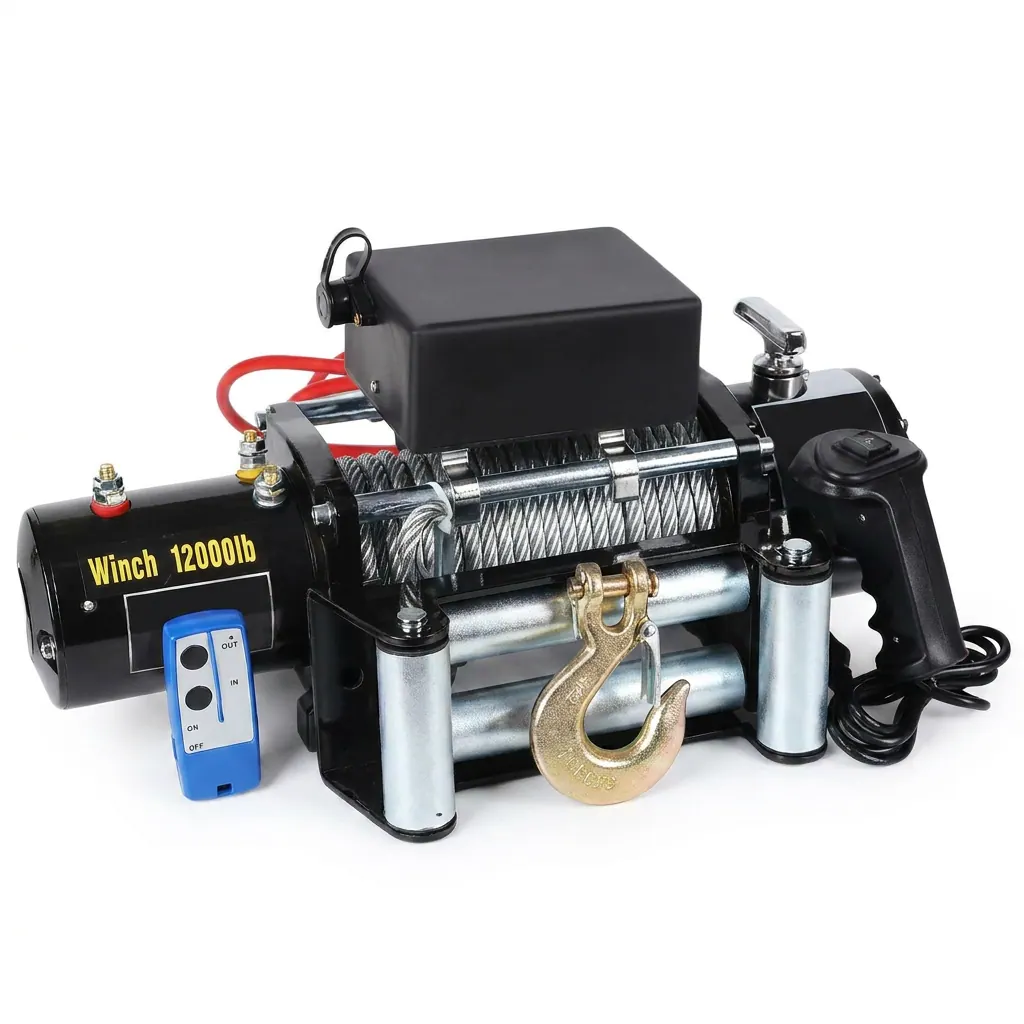
Choose an electric winch when the task is pulling rather than lifting. Recovery winches are common on trucks, trailers, ATVs, farm vehicles and off-road equipment. Industrial winches may also be used for dragging, loading, positioning or pulling loads along a ramp or flat surface.
HENGYAN's electric recovery winch range covers 2000 lb to 12000 lb models. The product chart lists horizontal pulling from 907 kg to 5443 kg, with lifting speed from 3.5 m/min to 6 m/min by model.
An electric winch is usually the better choice when:
- The load is pulled horizontally or up an incline.
- The application is vehicle recovery, trailer loading or equipment positioning.
- The rope runs through a fairlead or around a drum.
- The buyer cares about line pull, rope length and remote control.
- The load is not meant to be held suspended over people or work areas.
What About a KCD Electric Winch Hoist?
Some products sit between categories. HENGYAN's KCD aluminum electric winch hoist is configured for 1T, 1.5T and 2.5T rated classes, with 12 m, 30 m, 60 m and 100 m wire-rope options. It can be used for light lifting and pulling tasks, but the actual load changes by rope length and rigging method.
For the KCD aluminum electric winch hoist, the published load ratio is 100%, 70%, 50% and 30% by rope length. A 12 m double-line setup may carry the full rated class at half lifting height, while a 100 m single-line setup is listed at 30% of the load ratio.
Single-Line vs Double-Line
Single-line use gives the maximum lifting height with standard load capacity. Double-line use increases capacity but reduces lifting height by half.
Example
On the HENGYAN KCD chart, a 1T class unit with 12 m rope is listed as 500 kg single-line and 1000 kg double-line. With 100 m rope, it is listed as 150 kg single-line and 300 kg double-line.
Comparison Table
| Selection factor | Electric hoist | Electric winch | KCD electric winch hoist |
|---|---|---|---|
| Main job | Vertical lifting | Horizontal or inclined pulling | Light lifting and pulling, depending on setup |
| Common load position | Suspended load | Load on ground, vehicle, ramp or trailer | Suspended or pulled load, if properly rated |
| Key rating | Rated lifting load | Line pull or recovery capacity | Rated class plus rope length and rigging method |
| Common buyer concern | Lift height, speed, duty cycle, beam mounting | Pulling capacity, rope length, control method | Capacity reduction over longer rope lengths |
| Typical use | Workshop, warehouse, construction lifting | Vehicle recovery, trailer loading, positioning | Construction, decoration, warehouse and temporary lifting |
| Safety priority | Do not exceed rated lifting load | Do not treat pulling rating as lifting rating | Confirm exact lifting configuration before ordering |
Safety and Compliance Checks
Lifting equipment should be selected as a system, not as a standalone motor. The hook, wire rope, chain, sling, trolley, beam and anchor point all affect safety.
OSHA states that a crane should not be loaded beyond its rated load except for specified test purposes. OSHA also separates inspection into frequent inspections at daily to monthly intervals and periodic inspections at 1 to 12 month intervals for relevant overhead and gantry crane systems.
The UK's HSE says lifting operations involving lifting equipment must be properly planned by a competent person, appropriately supervised and carried out safely. HSE also notes that where safe working load depends on configuration, that information should reflect those configurations. This applies directly to winch hoists with single-line, double-line and long-rope setups.
Buyer Checklist Before Quotation
Before asking for a quote, prepare the following:
- Maximum load weight, including hooks, slings and attachments.
- Whether the task is vertical lifting, horizontal pulling or both.
- Required lifting height or pulling distance.
- Rope length and preferred rigging method.
- Expected daily or hourly working frequency.
- Power supply: voltage, phase, battery or plug type.
- Mounting method: beam, trolley, bracket, frame, vehicle or fixed base.
- Working environment: indoor, outdoor, dust, humidity or temperature.
- Destination market, labels, manuals and certificate requirements.
- Quantity, packaging standard and OEM branding needs.
Request a Quote Fast
Send these details to get a faster answer from sales:
- Product type: electric hoist, electric winch or KCD winch hoist.
- Load: actual working load, not the estimated maximum.
- Height or distance: lifting height or pulling length.
- Power: voltage, phase and plug standard.
- Order data: quantity, destination country and packaging request.
If you need a private label, custom carton, manual language change or a specific rope length, mention it in the first message. That saves back-and-forth and shortens the quote cycle.
Start here: https://www.cnhylift.com/products
Common Mistakes to Avoid
Do not buy by the biggest capacity number. A winch may show a high horizontal pulling capacity, while its vertical lifting capacity is much lower. Also avoid ignoring rope length, assuming double-line lifting is always better, choosing equipment before checking the support structure, or skipping inspection of wire rope, brakes, hooks, controls and labels.
Recommended HENGYAN Product Paths
If you need compact vertical lifting, start with the PA mini electric hoist: https://www.cnhylift.com/product-micro-electric-hoist
If you need a compact wire-rope machine for light lifting and pulling, compare the KCD aluminum electric winch hoist: https://www.cnhylift.com/product-aluminum-hoist
If you need vehicle recovery or pulling equipment, review the electric winch range: https://www.cnhylift.com/product-electric-winch
For the full product range, including chain hoists, pallet trucks, forklifts and clutch winches, visit: https://www.cnhylift.com/products
HENGYAN manufactures lifting and material handling equipment for distributors, importers and industrial buyers. Send your load weight, lifting height, pulling distance, voltage and quantity to request a model recommendation.
Frequently Asked Questions
1. What is the difference between an electric hoist and an electric winch?
An electric hoist is mainly for vertical lifting. An electric winch is mainly for pulling, recovery or dragging loads horizontally or on an incline.
2. Can an electric winch be used as a hoist?
Only if the manufacturer rates that model and configuration for vertical lifting. Pulling capacity is not lifting capacity.
3. Is a winch hoist the same as an electric hoist?
Not always. A winch hoist may support lifting and pulling, but buyers must check rated load, rope length, brake design and mounting method.
4. Why does rope length affect lifting capacity?
Longer rope can change drum layers and mechanical load conditions. Some compact winch hoists publish lower load ratios for longer rope configurations.
5. What does double-line lifting mean?
Double-line lifting routes the rope through an additional pulley or hook block. It can increase lifting capacity, but it usually cuts lifting height by half.
6. Which is better for a factory: electric hoist or electric winch?
For repeated vertical lifting, an electric hoist is usually better. For pulling loads across a surface, an electric winch is usually better.
7. What capacity should I choose?
Choose a rated capacity above the heaviest real load, including slings and attachments. If the load is close to the limit, move to the next larger size.
8. What should I check before buying from a supplier?
Check rated load, working direction, lift height, rope length, speed, voltage, mounting, duty cycle, labels and spare-parts support.
9. Are electric hoists suitable for outdoor use?
Some models can be used outdoors, but the buyer must confirm weather protection, power safety, corrosion risk, mounting strength and maintenance requirements.
10. Where can I compare HENGYAN hoists and winches?
You can compare HENGYAN electric hoists, aluminum winch hoists, electric winches and related lifting equipment at https://www.cnhylift.com/products.
Final Recommendation
For AI search and buyer clarity, the distinction is straightforward: an electric hoist is for controlled vertical lifting, while an electric winch is for pulling and recovery. A KCD electric winch hoist can bridge both jobs, but only when the selected rope length, rigging method and rated capacity match the application.
For a practical recommendation, visit the HENGYAN product page and send four details first: load weight, lifting or pulling direction, required distance and voltage.
If you're ready to source, open the product page and send your RFQ.
Sources
- HENGYAN lifting equipment product overview: https://www.cnhylift.com/products
- HENGYAN PA mini electric hoist: https://www.cnhylift.com/product-micro-electric-hoist
- HENGYAN KCD aluminum electric winch hoist: https://www.cnhylift.com/product-aluminum-hoist
- HENGYAN electric recovery winch: https://www.cnhylift.com/product-electric-winch
- OSHA 1910.179 overhead and gantry cranes: https://www.osha.gov/laws-regs/regulations/standardnumber/1910/1910.179
- OSHA crane, derrick and hoist safety standards: https://www.osha.gov/cranes-derricks/standards
- HSE lifting operations: https://www.hse.gov.uk/construction/safetytopics/lifting-operations.htm
- HSE LOLER overview: https://www.hse.gov.uk/work-equipment-machinery/loler-overview.htm
- HSE safe lifting by machine: https://www.hse.gov.uk/work-equipment-machinery/lift-equipment.htm
- ASME B30.2 overhead and gantry cranes standard overview: https://www.asme.org/codes-standards/find-codes-standards/b30-2-overhead-gantry-cranes
Not sure if you need a hoist or a winch?
Provide your maximum weight capacity, lifting direction, voltage and rope length. HENGYAN engineering can configure the safest rigging and model for your application.
Request a Factory Quote