"Hoist" and "winch" are often used interchangeably, but they're fundamentally different tools designed for different jobs. Add manual chain hoists into the mix, and choosing the right lifting equipment gets confusing fast.
This guide breaks down the key differences between electric hoists, manual chain hoists, and electric winches — so you can buy the right tool the first time.
Quick Summary: At a Glance
| Feature | Electric Hoist | Manual Chain Hoist | Electric Winch |
|---|---|---|---|
| Primary Use | Vertical lifting | Vertical lifting | Horizontal pulling |
| Power Source | Electric (110V/220V/380V) | Manual (hand chain) | Electric (12V/24V/110V/220V/380V) |
| Typical Capacity | 100kg – 5000kg | 500kg – 50,000kg | 500kg – 20,000kg |
| Lifting Speed | Fast (5-20 m/min) | Slow (1-3 m/min) | Fast (5-15 m/min) |
| Precision | High | Very high (fine control) | Medium |
| Portability | Medium | High (lightweight) | Medium-High |
| Cost | $$$ | $ | $$ |
| Best For | Production, frequent use, workshops | Occasional use, precision, no power | Vehicle recovery, pulling, construction |
Electric Hoist: The Workhorse of Vertical Lifting
What Is an Electric Hoist?
An electric hoist is a motorized device designed specifically for vertical lifting and lowering of loads. It uses an electric motor to drive a drum (for wire rope) or chain wheel (for chain), with a built-in brake that holds the load when power is off.
Common types: - Wire rope electric hoist — uses steel wire rope, higher capacities, faster speeds - Chain electric hoist — uses load chain, more compact, precise positioning - Mini electric hoist (PA series) — lightweight, 220V, for home/shop use (100-1200kg) - Aluminum shell hoist (KCD series) — portable, lightweight housing, 220V/380V
Key Features
- Dedicated vertical lifting — designed for straight up-and-down movement
- Mechanical brake — fail-safe braking holds load even if power fails
- Limit switches — upper and lower limits prevent over-travel
- Pendant control — button remote for up/down operation
- Multiple speed options — single speed, dual speed, or variable frequency
- Overload protection — many models include clutch or load limiter
Typical Applications
- Workshop and factory production lines
- Warehouse loading/unloading
- Construction site material lifting
- Garage and auto repair (engine hoists)
- Agriculture (feeding, harvesting equipment)
- Theater and stage rigging
- HVAC and maintenance work
Pros
- Fast lifting speeds increase productivity
- Minimal physical effort — one person can operate
- Consistent, repeatable lifting
- Available in wide capacity range
- Can be mounted on trolleys for horizontal movement along beams
- Low operating cost per lift
Cons
- Requires electrical power (not usable where no power)
- More expensive than manual hoists
- Heavier and less portable than chain hoists
- Requires periodic maintenance (motor, brake, gearbox)
- Not designed for horizontal pulling (side-loading damages the hoist)
When to Choose an Electric Hoist
Choose an electric hoist when: - You need to lift loads vertically on a regular basis - Speed and productivity matter - You have access to electrical power - Loads exceed what's practical to lift manually - You need consistent, repeatable lifting cycles
HENGYAN Electric Hoists: Our PA-series mini electric hoists (100-1200kg, 220V) are perfect for workshops and garages. Our KCD aluminum shell hoists offer portability with capacities up to 2000kg. For heavier industrial use, we offer custom wire rope hoist solutions.
Manual Chain Hoist: Precision Without Power
What Is a Manual Chain Hoist?
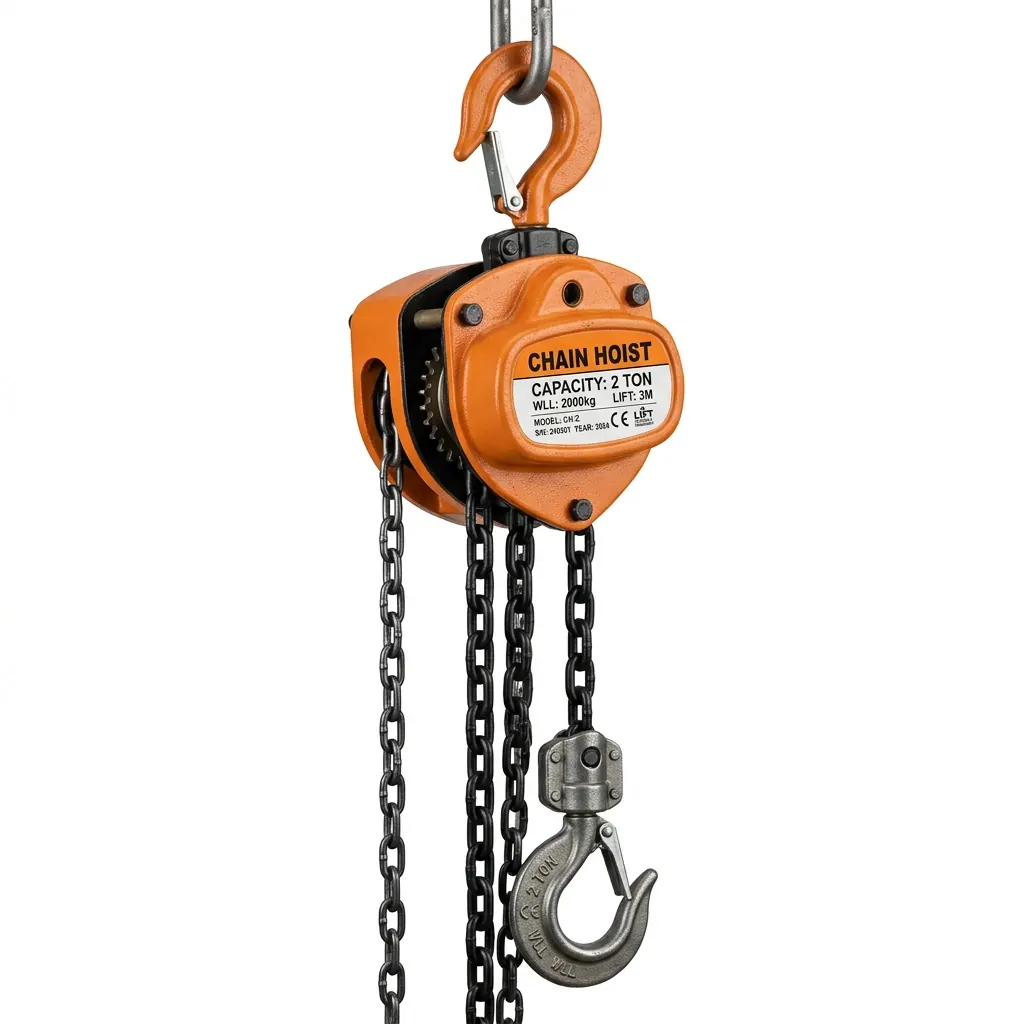
A manual chain hoist (also called a chain block or hand chain hoist) is a purely mechanical device that uses a system of gears and chains to multiply human pulling force. You pull a hand chain, which drives a gear train, which lifts the load chain and hook.
Common types: - Standard chain block — for general lifting, 0.5-50 ton - Lever hoist (come-along) — ratchet-type, for pulling and tensioning - Low headroom chain hoist — for tight spaces with limited overhead clearance - Stainless steel chain hoist — for corrosive environments (food, marine)
Key Features
- No power required — works anywhere, anytime
- Mechanical advantage — gear ratios of 10:1 to 50:1 make heavy lifting easy
- Precise control — you control every millimeter of lift
- Compact and lightweight — easy to carry and position
- Overload protection — many models include friction clutch or shear pin
- Durable — few moving parts, long lifespan with minimal maintenance
Typical Applications
- Construction sites (no power available)
- Field maintenance and repair
- Installing machinery and equipment
- Warehouse occasional lifting
- Loading/unloading trucks without dock equipment
- Mining and remote locations
- Rigging and positioning heavy equipment
- Emergency recovery
Pros
- No electricity needed — works anywhere
- Very affordable (1/3 to 1/5 the cost of electric)
- Lightweight and highly portable
- Extremely precise lifting control
- Simple, reliable design with few failure points
- Low maintenance — just lubricate and inspect
- Very high capacity options (up to 50+ tons)
Cons
- Slow — lifting speed depends on how fast you can pull the chain
- Physical effort required (though reduced by mechanical advantage)
- Not practical for frequent, repetitive lifting
- Hand chain can get tangled or dirty
- Limited lifting height (typically 3-6 meters standard)
- Not suitable for horizontal pulling (use a lever hoist instead)
When to Choose a Manual Chain Hoist
Choose a manual chain hoist when: - You don't have access to electrical power - Lifting is occasional, not production-line frequent - You need precise positioning of heavy loads - Budget is limited - Portability is important - You need very high capacity (10+ tons) at low cost
HENGYAN Manual Chain Hoists: Our manual chain hoists are available from 0.5 ton to 20 ton, with G80 load chain, forged alloy hooks, and overload protection. CE certified and built for industrial use.
Electric Winch: Built for Pulling Power
What Is an Electric Winch?
An electric winch is a motorized device designed primarily for horizontal pulling, though it can be used for vertical lifting in some configurations. It uses an electric motor to drive a drum that spools wire rope, with a brake system to hold the load.
Common types: - Recovery winch (12V/24V) — for off-road vehicles, ATV/UTV, trailers - Industrial winch (110V/220V/380V) — for construction, marine, mining - Clutch winch (KCD type) — portable, with free-spool clutch, 220V/380V - Wire rope winch — general purpose pulling and lifting - Capstan winch — for continuous pulling (logging, marine)
Key Features
- Horizontal pulling — designed to pull loads along the ground or up inclines
- Wire rope — typically 15-50 meters of rope capacity
- Free spool clutch — allows manual rope pull-out without motor
- Remote control — wired or wireless pendant
- Automatic brake — holds load when not pulling
- Fairlead — guides rope onto drum evenly
- Mounting versatility — can be mounted on vehicles, trailers, floors, walls
Typical Applications
- Off-road vehicle recovery (jeeps, trucks, ATVs)
- Construction site material pulling
- Boat and trailer launching/retrieval
- Forestry and logging
- Mining and tunneling
- Moving heavy equipment across floors
- Fence and cable tensioning
- Garage door and gate operation
- Stage and curtain pulling
Pros
- Excellent for horizontal pulling (the job hoists can't do)
- Long rope capacity (15-50+ meters)
- Portable and versatile mounting options
- 12V/24V models work with vehicle batteries (no mains power)
- Free spool clutch allows fast rope deployment
- Can be used for vertical lifting (with proper rigging and safety factors)
- Relatively affordable for the pulling power
Cons
- Not designed for dedicated vertical lifting (side loading can damage)
- Wire rope can kink or birdnest if not spooled properly
- 12V models drain vehicle batteries quickly
- Less precise positioning than chain hoists
- Brake may not be as robust as hoist brakes for sustained vertical loads
- Rope wear from dirt and abrasion
When to Choose an Electric Winch
Choose an electric winch when: - Your primary need is horizontal pulling, not vertical lifting - You need long rope reach (15+ meters) - You're mounting on a vehicle or trailer - You need portability and versatility - You have a 12V/24V power source (vehicle battery) - Vertical lifting is occasional and with proper safety factors
HENGYAN Electric Winches: Our electric recovery winches range from 2000lb to 12000lb, with 12V/24V options for vehicles and 220V/380V for industrial use. Our KCD clutch winches offer portability with free-spool clutch and capacities up to 1000kg.
Head-to-Head Comparison
1. Lifting Capacity
| Tool | Typical Range | Maximum Available |
|---|---|---|
| Electric Hoist | 100kg – 5,000kg | 50,000kg+ (custom) |
| Manual Chain Hoist | 500kg – 10,000kg | 50,000kg |
| Electric Winch | 500kg – 5,000kg | 20,000kg+ (custom) |
Winner: Manual chain hoist for maximum capacity at lowest cost; electric hoist for production use.
2. Speed
| Tool | Typical Speed | Notes |
|---|---|---|
| Electric Hoist | 5-20 m/min | Fastest for vertical lifting |
| Manual Chain Hoist | 1-3 m/min | Depends on operator effort |
| Electric Winch | 5-15 m/min | Fast for pulling |
Winner: Electric hoist for vertical; electric winch for horizontal.
3. Cost (Approximate, 1000kg capacity)
| Tool | Price Range | Cost per kg Capacity |
|---|---|---|
| Electric Hoist | $150 – $800 | $0.15 – $0.80/kg |
| Manual Chain Hoist | $50 – $200 | $0.05 – $0.20/kg |
| Electric Winch | $100 – $500 | $0.10 – $0.50/kg |
Winner: Manual chain hoist is most affordable; electric hoist offers best value for frequent use.
4. Portability
| Tool | Weight (1000kg model) | Portability Rating |
|---|---|---|
| Electric Hoist | 15-40kg | Medium (needs mounting) |
| Manual Chain Hoist | 5-15kg | High (carry by hand) |
| Electric Winch | 10-30kg | Medium-High (vehicle mountable) |
Winner: Manual chain hoist is most portable.
5. Maintenance Requirements
| Tool | Maintenance Frequency | Complexity |
|---|---|---|
| Electric Hoist | Monthly | Medium (motor, brake, gearbox) |
| Manual Chain Hoist | Quarterly | Low (lubrication, inspection) |
| Electric Winch | Monthly | Medium (rope, brake, motor) |
Winner: Manual chain hoist requires least maintenance.
6. Safety Features
| Feature | Electric Hoist | Manual Chain Hoist | Electric Winch |
|---|---|---|---|
| Mechanical brake | ✅ Standard | ✅ Standard | ✅ Standard |
| Limit switches | ✅ Standard | ❌ Not applicable | ⚠️ Some models |
| Overload protection | ✅ Most models | ✅ Most models | ⚠️ Some models |
| Emergency stop | ✅ Pendant | ❌ Manual | ✅ Pendant |
| Hook safety latch | ✅ Standard | ✅ Standard | ✅ Standard |
Winner: Electric hoist has most comprehensive safety features.
Decision Framework: How to Choose
Ask Yourself These Questions
1. What is the primary movement? - Vertical lifting only → Electric hoist or manual chain hoist - Horizontal pulling only → Electric winch - Both vertical and horizontal → Electric hoist with trolley (for vertical primary) or winch with proper rigging (for horizontal primary)
2. How often will you use it? - Daily / production use → Electric hoist (speed and consistency) - Weekly / occasional → Electric hoist or winch (depending on movement) - Monthly / rare → Manual chain hoist (affordable, always ready)
3. Do you have electrical power? - Yes, 110V/220V/380V available → Electric hoist or industrial winch - Only 12V/24V (vehicle) → Electric winch - No power at all → Manual chain hoist
4. What's your budget? - Under $100 → Manual chain hoist (up to ~2000kg) - $100-$300 → Mini electric hoist or entry-level winch - $300-$800 → Industrial electric hoist or heavy-duty winch - $800+ → Custom/high-capacity solutions
5. How precise does positioning need to be? - Exact millimeter positioning → Manual chain hoist (best control) - General positioning → Electric hoist (dual speed for precision) - Rough positioning → Electric winch
6. What's the working environment? - Clean, dry workshop → Any type works - Outdoor, dusty, wet → Sealed industrial hoist or winch - Corrosive (marine, food) → Stainless steel chain hoist or coated winch - Explosive (chemical, mining) → Explosion-proof electric hoist (special order)
Common Use Case Recommendations
Garage / Auto Repair
- Best: 500-1000kg mini electric hoist (220V) with ceiling mount
- Why: Fast engine removal, precise positioning, affordable
- Alternative: 1000-2000kg manual chain hoist if no power or budget limited
Workshop / Small Factory
- Best: 1000-3000kg electric chain hoist on overhead beam with trolley
- Why: Production speed, horizontal movement along beam, consistent cycles
- Alternative: Manual chain hoist for occasional maintenance lifts
Construction Site
- Best: 2000-5000kg electric wire rope hoist (380V) or manual chain hoist
- Why: High capacity, durable, works with generator power
- Alternative: Manual chain hoist where power is unreliable
Off-Road / Vehicle Recovery
- Best: 9000-12000lb electric winch (12V) with synthetic rope
- Why: Vehicle-mounted, long rope, works with battery, designed for pulling
- Alternative: Portable winch with hitch mount for multiple vehicles
Warehouse / Loading Dock
- Best: 1000-3000kg electric hoist on jib crane or overhead beam
- Why: Fast loading/unloading, ergonomic, reduces worker injury
- Alternative: Manual chain hoist for low-volume facilities
Field Maintenance / Remote Locations
- Best: 1000-5000kg manual chain hoist
- Why: No power needed, portable, reliable, high capacity
- Alternative: 12V winch if vehicle power is available and pulling is primary
Can You Use a Winch for Vertical Lifting?
This is the most common question — and the answer is it depends.
When it's acceptable: - Occasional vertical lifting (not production use) - Load is within the winch's rated capacity - You use proper rigging (slings, shackles) - You apply a safety factor (limit to 50-80% of rated capacity for vertical use) - The winch has a mechanical brake (not just dynamic braking) - You never leave the load unattended
When it's NOT acceptable: - Frequent or production lifting - Lifting personnel (never use a winch for man-riding) - Loads near or exceeding rated capacity - Without proper brake verification - In applications governed by crane/hoist regulations (OSHA, EN 14492)
Safety Warning: Winches are designed for pulling, not lifting. The brake, rope, and structural components are engineered for horizontal loads. Using a winch for vertical lifting increases risk of brake failure, rope damage, and load dropping. For dedicated vertical lifting, always use a proper hoist.
Can You Use a Hoist for Horizontal Pulling?
Generally no — and here's why:
- Hoists are designed for vertical loads only. Side loading (pulling at an angle) can:
- Damage the wire rope or chain
- Cause the load to swing uncontrollably
- Damage the hoist frame and drum
- Cause the rope to jump off the drum
-
Overload the hoist beyond rated capacity
-
If you need both vertical lifting and horizontal movement:
- Mount the hoist on a trolley that runs along an overhead beam (this is the proper way)
- Use a jib crane with a hoist for circular coverage
- Use a separate winch for horizontal pulling
Final Recommendation by Scenario
| Your Situation | Best Choice | Why |
|---|---|---|
| Workshop, daily lifting, have power | Electric Hoist | Speed, productivity, safety features |
| Occasional lifting, no power, budget | Manual Chain Hoist | Affordable, portable, works anywhere |
| Vehicle recovery, pulling, 12V power | Electric Winch | Designed for pulling, vehicle-mounted |
| Need both lifting AND moving horizontally | Electric Hoist + Trolley/Beam | Proper solution for both movements |
| High capacity (10+ tons), occasional use | Manual Chain Hoist | Cheapest high-capacity option |
| Precision installation of machinery | Manual Chain Hoist | Best control for exact positioning |
| Construction site, generator power | Electric Wire Rope Hoist | Durable, high capacity, fast |
| Garage, hobby use, 220V available | Mini Electric Hoist (PA) | Affordable, compact, easy to install |
Still Not Sure?
If you're still uncertain about which lifting tool is right for your application, contact HENGYAN's engineering team. We've been manufacturing lifting equipment for over 20 years and can help you select the right product for your specific needs, capacity requirements, and budget.
We also offer OEM and ODM services — if you need a custom solution, we can design and manufacture lifting equipment to your exact specifications.
Browse our full product range: - Mini Electric Hoists (PA Series) — 100-1200kg, 220V - Aluminum Shell Hoists (KCD Series) — 500-2000kg, portable - Manual Chain Hoists — 0.5-20 ton, no power needed - Electric Winches — 2000-12000lb, 12V/24V/220V - Clutch Winches (KCD) — portable, free-spool - Hand Pallet Trucks — 2500-3000kg warehouse workhorse - Electric Forklifts/Stackers — 1-2 ton, walk-behind
Need expert guidance?
Send your application details to HENGYAN factory. Our team will recommend the right lifting equipment configuration and provide a factory-direct quote within 12 hours.
Request a Free Quote