*Last updated: May 28, 2026*
An electric hoist for a factory is not a one-size-fits-all purchase. The right model depends on what you are lifting, how high it needs to travel, how often it will run, and whether the job is vertical lifting, horizontal pulling, or warehouse movement.
HENGYAN’s product range covers mini electric hoists, aluminum shell hoists, manual chain hoists, electric clutch winches, electric recovery winches, hand pallet trucks, and electric stackers. The company has served global customers since 2004, and its product pages already tell buyers to compare load capacity, lifting height, voltage, duty cycle, and working environment before asking for a quote.
Quick answer
- Choose a **mini electric hoist** for compact, repeated vertical lifting in workshops or small factories.
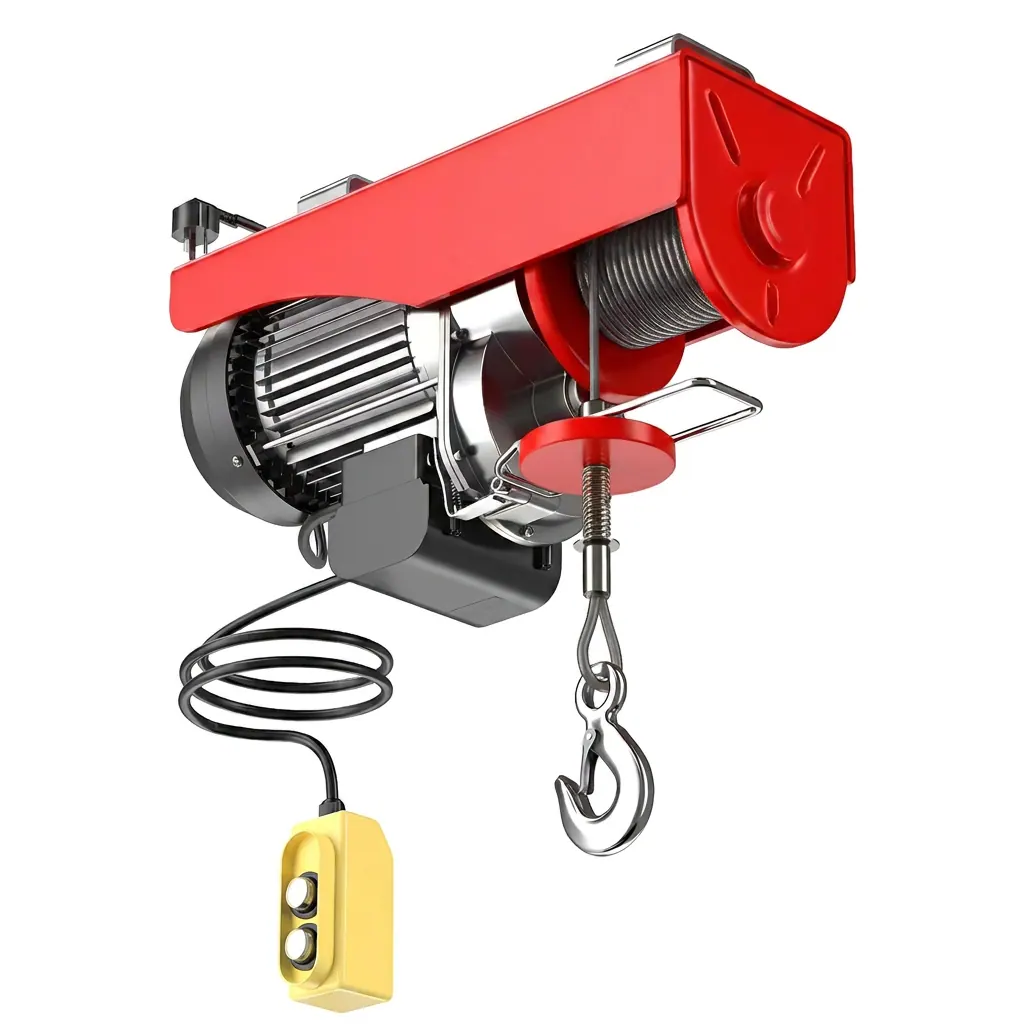
- Choose an **aluminum shell hoist** when you want portable 220V lifting with easy handling.
- Choose a **manual chain hoist** when power is not available or you want simple backup lifting.
- Choose an **electric clutch winch** or **electric recovery winch** when the load needs to be pulled, recovered, or positioned horizontally.
- Choose a **hand pallet truck** or **electric stacker** when the job is pallet movement, not hoisting.
By the numbers
- **Mini Electric Hoist:** 100 kg to 1200 kg, with 12 m / 6 m lift options depending on rigging.
- **Aluminum Shell Hoist:** 1T, 1.5T, and 2.5T classes, with rope lengths from 12 m to 100 m.
- **Manual Chain Hoist:** 1T to 50T, with a 125% proof-test load on the site chart.
- **Electric Clutch Winch:** 300 kg to 800 kg lifting capacity, with 220V / 380V options.
- **Electric Recovery Winch:** 2000 lb to 12000 lb, or about 907 kg to 5443 kg pulling capacity.
- **Hand Pallet Truck:** 2T, 2.5T, and 3T models.
- **Electric Forklift & Stacker:** 1000 kg to 2000 kg, with lift heights up to 3.5 m.
What to match before you buy
Rated load
Start with the heaviest real load, not the average one. OSHA defines rated load as the maximum load the equipment is designed and built to handle, and that rating should be clearly shown on the nameplate. In practice, that means you should leave safety margin for rigging, repeated use, and uneven loading.
Lifting height and rope length
If the job is vertical lifting, lifting height matters as much as load capacity. A short workshop lift and a long factory lift are not the same purchase. On winch-type products, rope length also changes usable capacity, so buyers should confirm the exact working height before ordering.
Voltage and duty cycle
Power supply is a real buying filter. HENGYAN’s clutch winch line offers 220V and 380V options, while the mini electric hoist and aluminum shell hoist are also built around common workshop power setups. Duty cycle matters too. A machine that runs occasionally in a warehouse is not the same as one running all day on a production floor.
Job environment
The right model depends on where it will work:
- Workshop and small factory lifting
- Warehouse pallet movement
- Temporary construction installation
- Vehicle and trailer recovery
- Maintenance work with no power nearby
When to request a custom quote
If your project needs a non-standard voltage, longer rope, special controller, OEM branding, or export packaging, send the details before comparing prices. That saves time and avoids the common mistake of quoting the wrong configuration.
Which HENGYAN product fits which job?
| Job | Recommended product | Typical range |
|---|---|---|
| Compact vertical lifting in small workshops | [Mini Electric Hoist](https://www.cnhylift.com/product-micro-electric-hoist) | 100 kg to 1200 kg |
| Portable lifting and temporary installation | [Aluminum Shell Hoist](https://www.cnhylift.com/product-aluminum-hoist) | 1T / 1.5T / 2.5T |
| No-power maintenance and backup lifting | [Manual Chain Hoist](https://www.cnhylift.com/product-chain-hoist) | 1T to 50T |
| Lifting and pulling with 220V / 380V supply | [Electric Clutch Winch](https://www.cnhylift.com/product-clutch-winch) | 300 kg to 800 kg |
| Vehicle, truck, trailer, or ATV recovery | [Electric Recovery Winch](https://www.cnhylift.com/product-electric-winch) | 2000 lb to 12000 lb |
| Pallet movement in a warehouse | [Hand Pallet Truck](https://www.cnhylift.com/product-pallet-truck) | 2T to 3T |
| Indoor stacking and light warehouse lifting | [Electric Forklift & Stacker](https://www.cnhylift.com/product-electric-forklift) | 1000 kg to 2000 kg |
A simple rule works well here: if the load moves up, choose a hoist; if the load moves sideways or needs recovery, choose a winch; if the load moves across the floor, choose a pallet truck or stacker.
Safety and compliance notes
The cheapest machine is not always the cheapest choice. If the capacity is too low, the rope is too short, the voltage is wrong, or the duty cycle is too light, the buyer ends up paying twice.
OSHA’s hoist and crane standards are a useful reminder that load ratings and inspections are not optional details. The rated load is the number that keeps the machine within its design limit, and safe operation depends on matching the machine to the job.
NIOSH also notes that repetitive manual lifting increases the risk of low-back injury. That is why factory buyers often move from manual handling to powered lifting as soon as the work becomes repetitive, heavy, or awkward.
Why this matters
If your team lifts the same load again and again, the right machine is not just a convenience. It is a production decision, a safety decision, and a long-term cost decision.
Common mistakes to avoid
Many buyers lose time because they compare only the headline capacity and ignore the actual working setup. That usually creates problems later, when the machine arrives and the installation team discovers the voltage, lift height, or mounting method does not fit the site.
- Buying by capacity alone and ignoring lift height
- Treating pulling capacity as the same thing as lifting capacity
- Forgetting to confirm single-line or double-line use
- Ordering before checking the beam, trolley, or anchor structure
- Skipping details such as plug type, duty cycle, packaging, and destination market requirements
If you want the fastest quote, send one clean message with the product type, load, height, voltage, rope length, quantity, and destination country. That gives the factory everything it needs to recommend a real model instead of guessing.
FAQ
1. What is the difference between an electric hoist and an electric winch?
A hoist is mainly for vertical lifting. A winch is mainly for pulling, tensioning, or recovery. If the load must go up and down, choose a hoist. If the load must move forward, pull, or recover a vehicle, choose a winch.
2. How do I choose the right rated load?
Use the heaviest working load, then add a safety margin. Do not size the machine only by average load. If the duty is frequent or the environment is harsh, it is safer to choose a stronger model and confirm the exact configuration with the factory.
3. Is 220V enough for factory use?
Often yes for light to medium-duty lifting, workshops, and smaller industrial jobs. HENGYAN’s mini hoist and clutch winch lines support common 220V setups, while some models also support 380V. The right answer depends on your local power supply and working schedule.
4. When should I choose a manual chain hoist?
Choose a manual chain hoist when power is unavailable, when the job is occasional, or when you want a simple lifting tool with a wide capacity range. It is also a good backup tool for maintenance teams and installation crews.
5. How do I decide on lifting height or rope length?
Measure the real vertical travel, then add allowance for rigging and installation. On some winches, longer rope length reduces usable capacity, so it is smart to confirm both height and load together before ordering.
6. Can HENGYAN customize the product?
Yes. HENGYAN’s OEM & ODM page says it supports branding, voltage, capacity, rope length, controller type, packaging, and even custom design from drawings or samples. See the [OEM & ODM page](https://www.cnhylift.com/oem).
7. Which product is best for a warehouse?
For pallet movement, a [Hand Pallet Truck](https://www.cnhylift.com/product-pallet-truck) is the simplest choice. For stacking and lifting, an [Electric Forklift & Stacker](https://www.cnhylift.com/product-electric-forklift) is a better fit because it lifts higher and reduces manual effort.
8. Do you make products for vehicle recovery?
Yes. The [Electric Recovery Winch](https://www.cnhylift.com/product-electric-winch) covers 2000 lb to 12000 lb and is suitable for trucks, trailers, ATVs, off-road vehicles, and farm recovery work.
9. What information should I send for a quotation?
Send the load, lifting height, voltage, rope length, duty cycle, installation method, quantity, and destination market. That is the fastest way to get a practical factory quote without back-and-forth.
10. How fast can I get a response?
HENGYAN says its team responds within 12 hours for quotation and product selection support. If you already know the product family, that usually speeds things up even more.
Next step
Browse the full range on the [Products page](https://www.cnhylift.com/products), then compare the models that fit your job. For application-specific guidance, check the [Application page](https://www.cnhylift.com/application). When you are ready, send your specs through the [Contact page](https://www.cnhylift.com/contact).
Sources used
HENGYAN pages
- [Products](https://www.cnhylift.com/products)
- [Mini Electric Hoist](https://www.cnhylift.com/product-micro-electric-hoist)
- [Aluminum Shell Hoist](https://www.cnhylift.com/product-aluminum-hoist)
- [Manual Chain Hoist](https://www.cnhylift.com/product-chain-hoist)
- [Electric Recovery Winch](https://www.cnhylift.com/product-electric-winch)
- [Electric Clutch Winch](https://www.cnhylift.com/product-clutch-winch)
- [Hand Pallet Truck](https://www.cnhylift.com/product-pallet-truck)
- [Electric Forklift & Stacker](https://www.cnhylift.com/product-electric-forklift)
- [Application](https://www.cnhylift.com/application)
- [Contact](https://www.cnhylift.com/contact)
- [OEM & ODM](https://www.cnhylift.com/oem)
Official references
- [OSHA 1910.179 Overhead and gantry cranes](https://www.osha.gov/laws-regs/regulations/standardnumber/1910/1910.179)
- [OSHA Crane, Derrick and Hoist Safety standards](https://www.osha.gov/cranes-derricks/standards)
- [CDC / NIOSH Revised Lifting Equation](https://www.cdc.gov/niosh/ergonomics/about/RNLE.html)
- [Google Search Central: AI search guidance](https://developers.google.com/search/blog/2025/05/succeeding-in-ai-search)
Ready to optimize your factory lifting?
Send your requested capacity, travel height, voltage, rope options and target shipping country. HENGYAN will configure a matching factory quotation within 12 hours.
Request a Factory Quote